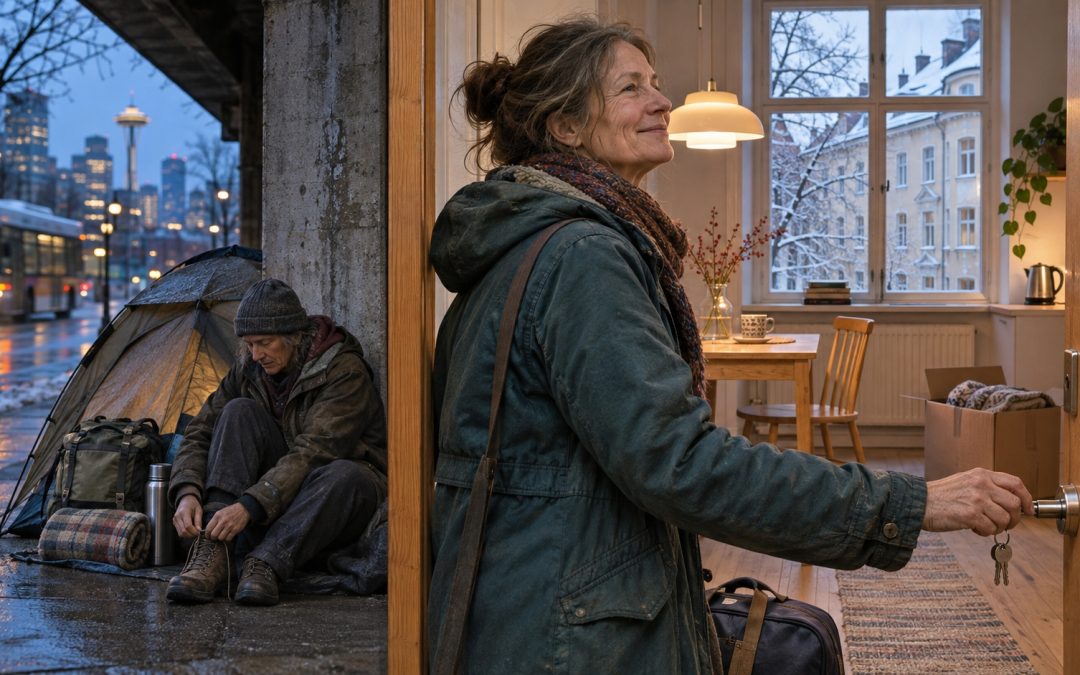
Walk through downtown Helsinki on a freezing January night, and you will notice something remarkable by its absence: there are no tent encampments under bridges, no rows of people huddled over steam grates, and no lines stretching around the block for emergency shelter beds.
Now, picture almost any major city in the United States, Los Angeles, New York, Seattle, or Phoenix. Despite unprecedented economic wealth, tens of thousands of Americans sleep on sidewalks, in cars, and in overcrowded shelters every single night.
For decades, conventional wisdom in the Western world treated chronic homelessness as an intractable tragedy, a complex web of addiction, mental illness, and personal misfortune that societies could at best manage, never cure. Yet one Nordic nation decided to challenge that assumption entirely. By flipping the traditional model of social support on its head, Finland has virtually eradicated street homelessness. Even more strikingly, they proved something that fiscal conservatives and progressive humanitarians alike can agree on: giving people homes is significantly cheaper than leaving them on the streets.
As we look toward building a more conscious, compassionate, and sustainable future, the stark contrast between Finland and the United States offers a vital blueprint for what happens when a society treats housing not as a reward to be earned, but as a fundamental human right.
Flipping the Script: The "Housing First" Philosophy
To understand Finland’s success, you have to understand how traditional homelessness systems work, and why they fail.
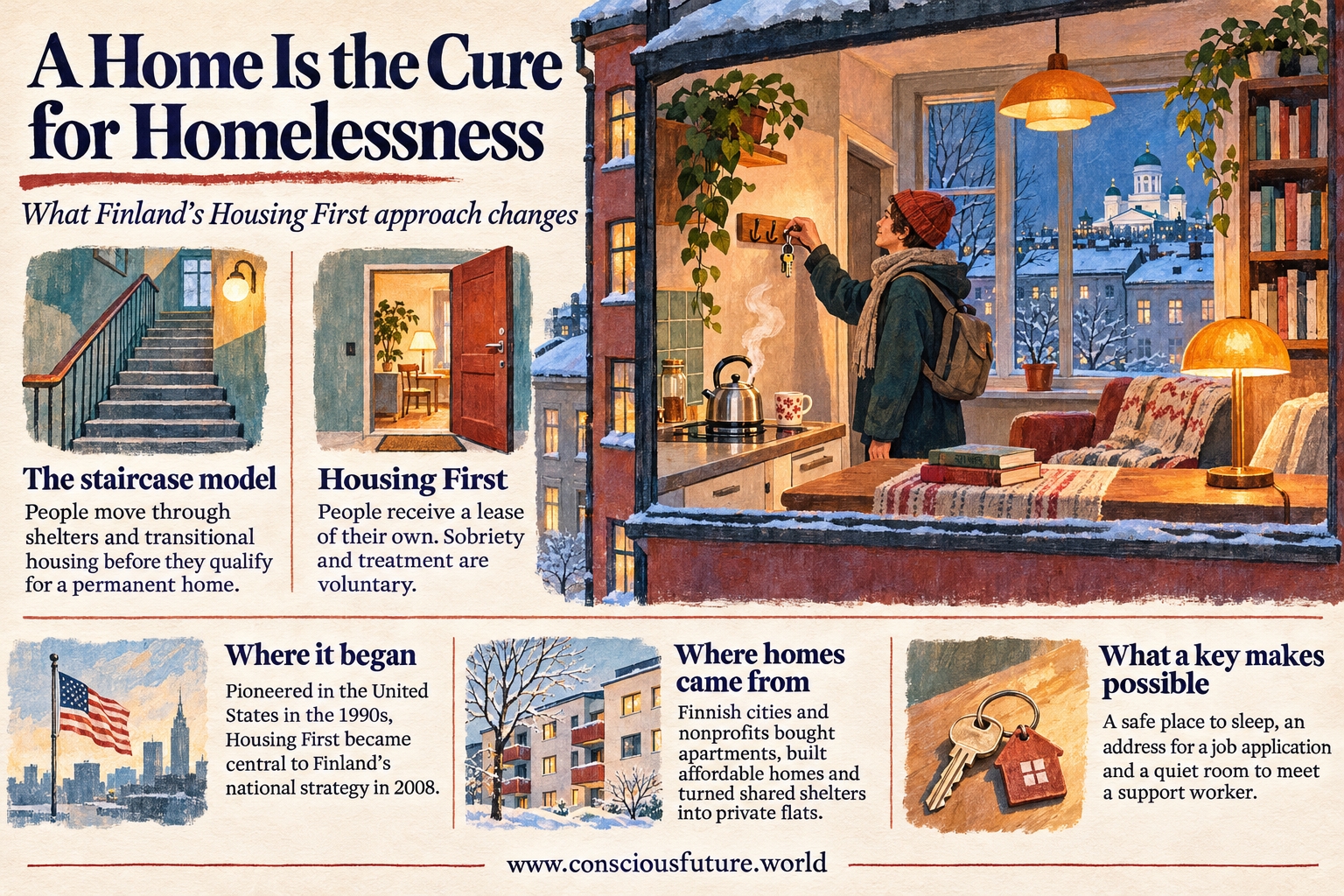
In the United States and much of Europe, the standard approach has long been the "staircase model." Under this system, an unhoused person must climb a series of rungs to prove they are "housing ready." First, they stay in an emergency shelter. To move to transitional housing, they must get sober, adhere to psychiatric treatment, and demonstrate financial stability. Only after jumping through these hoops do they earn the right to a permanent apartment.
The flaw in this logic is obvious to anyone who has ever tried to solve a complex life crisis without a safe place to sleep. Asking someone to overcome severe trauma, addiction, or mental illness while living on the street is like asking someone to swim while holding their head underwater. Without stability, people relapse, lose their shelter spots, and fall back to the bottom of the staircase.
In 2008, Finland abandoned the staircase model and went "all in" on a radical alternative called Housing First. Ironically, the concept was originally pioneered in the United States by psychologist Sam Tsemberis in the 1990s, yet it was Finland that adopted it as a unified national strategy.
The premise of Housing First is disarmingly simple: give a person a permanent, independent apartment with their own lease immediately, with no preconditions. They do not have to be sober. They do not have to be in therapy. Once the front door closes behind them and they have safety, privacy, and a mailing address, trained social workers and healthcare professionals step in to offer tailored, voluntary support.
The Finnish government, working alongside municipalities and non-profits like the Y-Foundation, began buying apartments on the private market, building new affordable housing blocks, and converting old, dormitory-style emergency shelters into private apartments with on-site support staff.
The results were transformative. Between 2008 and 2023, Finland saw 11 consecutive years of declining homelessness. While slight fluctuations occurred around 2025 due to rising living costs and global economic pressures, long-term homelessness has plummeted since the program began. Today, sleeping rough on the streets of Helsinki has nearly vanished, and the city operates just a single overnight emergency center.
The Economics of Compassion: Why Housing Saves Money
When policymakers in the United States balk at the idea of building or subsidizing permanent housing for the unhoused, the objection is almost always financial: How can we afford it?
Finland’s data flips that question on its head: How can we afford not to?
Leaving people to survive on the streets is astronomically expensive for taxpayers. Unhoused individuals are constantly in crisis. Exposure to the elements, untreated chronic illnesses, violence, and substance abuse mean they rely heavily on the most expensive public safety nets available: emergency room visits, ambulance rides, psychiatric hospitalizations, police interventions, and county jails.
In Finland, comprehensive government studies tracked the public costs of chronically homeless individuals before and after they were placed in Housing First apartments. The findings were indisputable: providing a person with a permanent home and wrap-around support services saves the Finnish state an average of €15,000 (roughly $16,000 to $22,000 USD) per person, per year.
Research showed that once people moved into stable housing, emergency room visits dropped by 60 percent, and days spent in hospitals or rehabilitation centers plummeted. While the upfront investment in constructing and purchasing apartments cost hundreds of millions of euros over a decade, the downstream savings in healthcare, policing, and justice costs more than paid for the program.
Similar pilot programs in the United States, from Utah to Denver, have repeatedly confirmed the exact same math. Every chronically unhoused person left on American streets costs taxpayers tens of thousands of dollars annually in emergency interventions. Housing them costs a fraction of that.
Two Nations, Two Choices: Finland vs. The United States
If the science, the ethics, and the economics all point in the exact same direction, why is Finland approaching zero street homelessness while the United States faces a worsening humanitarian crisis?
The divergence comes down to political will, social infrastructure, and cultural philosophy.
First, Finland treats housing as a constitutional and social priority, backed by a strong universal safety net. Municipalities own vast amounts of land, Helsinki owns roughly 70 percent of the land within its borders, allowing the city to mandate that new developments include a mix of social, affordable, and market-rate housing. This prevents the creation of segregated "ghettos" and keeps neighborhoods integrated.
In contrast, the United States treats housing primarily as a speculative financial asset. Decades of underinvestment in public housing, restrictive zoning laws, and NIMBYism ("Not In My Backyard") have created a catastrophic shortage of affordable rentals. In many U.S. cities, even working full-time at minimum wage is not enough to afford a one-bedroom apartment.
Second, the U.S. leans toward criminalization rather than care. While Finland replaced shelters with apartments, many American cities have responded to visible poverty by passing laws that ban sleeping in public, conducting violent encampment "sweeps" that destroy people’s belongings and IDs, and cycling vulnerable people through jails. Sweeps do not end homelessness; they merely push suffering from one block to another while severing individuals from the very outreach workers trying to help them.
Finally, there is a deep cultural divide regarding deservingness. American policy is often haunted by a puritanical suspicion that giving people something "for free" rewards bad behavior. Finnish policy, by contrast, is rooted in pragmatic solidarity. As Juha Kaakinen, former CEO of the Y-Foundation and one of the architects of Finland’s strategy, famously put it: "You don't solve social problems by making people's lives harder."
Beyond the Stigma: Trauma and Untapped Potential
What public debates around homelessness frequently overlook is the human story beneath the surface. Few people end up on the streets simply because of bad choices; the vast majority carry deep, unhealed wounds, often stemming from severe childhood trauma, abuse, neglect, or sudden personal catastrophe. When society judges unhoused individuals solely by their outward struggles, it mistakes the symptoms of trauma for a lack of character.
Yet when these individuals are finally given safety, stability, and the right support, a remarkable transformation occurs. Freed from the daily fight for survival, people can begin to heal, rediscover their strengths, and re-engage with the world around them. Far from being a permanent drain on society, many go on to become vital contributors, returning to the workforce, creating art, volunteering, or acting as peer mentors who guide others out of the very darkness they once survived.
A Blueprint for a Conscious Future
Finland is not a utopia, and its leaders are the first to admit that ending homelessness requires constant vigilance against rising rents and economic shifts. Yet their achievement stands as one of the greatest social policy triumphs of the twenty-first century.
For a conscious, forward-looking world, the lesson of Finland is profound. Homelessness is not an inevitable byproduct of modern city life, nor is it a moral failing of the poor. It is a policy choice. When we choose to view our unhoused neighbors not as problems to be policed, but as human beings who simply need a key to their own front door, everyone wins, the individual reclaims their dignity, communities become safer and more cohesive, and society saves billions in wasted crisis spending.
A home is not the reward at the end of recovery. It is the foundation where recovery begins.
INFOGRAPHIC