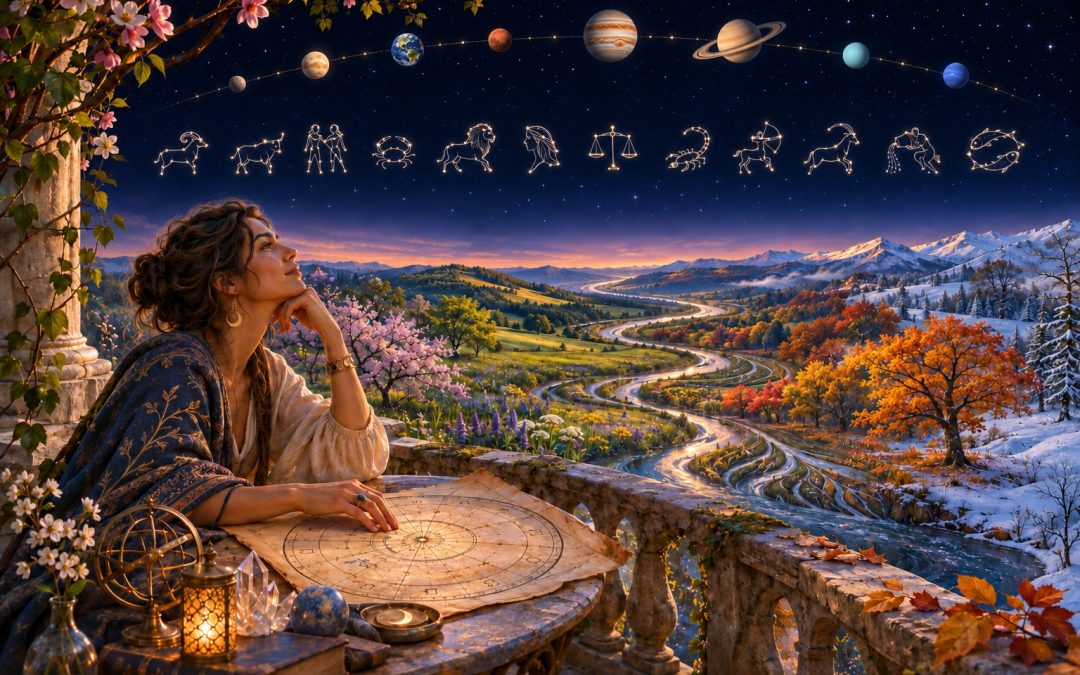
Beyond newspaper horoscopes lies an ancient symbolic framework for self-understanding, cyclical awareness, and our place within a living cosmos.
When most people hear the word astrology, a familiar image comes to mind: a narrow column at the back of a newspaper offering three vague sentences about love or money, or a playful social media post teasing Scorpios for being intense and Libras for struggling to pick a restaurant. If that is your main impression of the subject, it is entirely understandable to dismiss it as harmless entertainment.
Sun-sign horoscopes are to real astrology what a single painted brick is to a cathedral. They are a tiny, commercialized fragment of a discipline that is thousands of years old, mathematically precise, psychologically nuanced, and philosophically rich.
At its heart, serious astrology is neither fortune-telling nor superstition. It is a symbolic language, a way of reading the rhythms of time and the architecture of human experience. Rather than claiming the planets dictate our lives like puppeteers pulling invisible strings, astrology offers a mirror. It helps us understand our innate tendencies, recognize the seasons of growth and challenge we are moving through, and remember something modern culture often forgets: we are not isolated observers standing apart from the universe, but participants woven into its patterns.
Four Thousand Years of Watching the Heavens
Long before artificial light erased the night sky from our cities, looking up was humanity’s most natural way of orienting itself in space and time. The sky was our first calendar, our first compass, and our first clock.
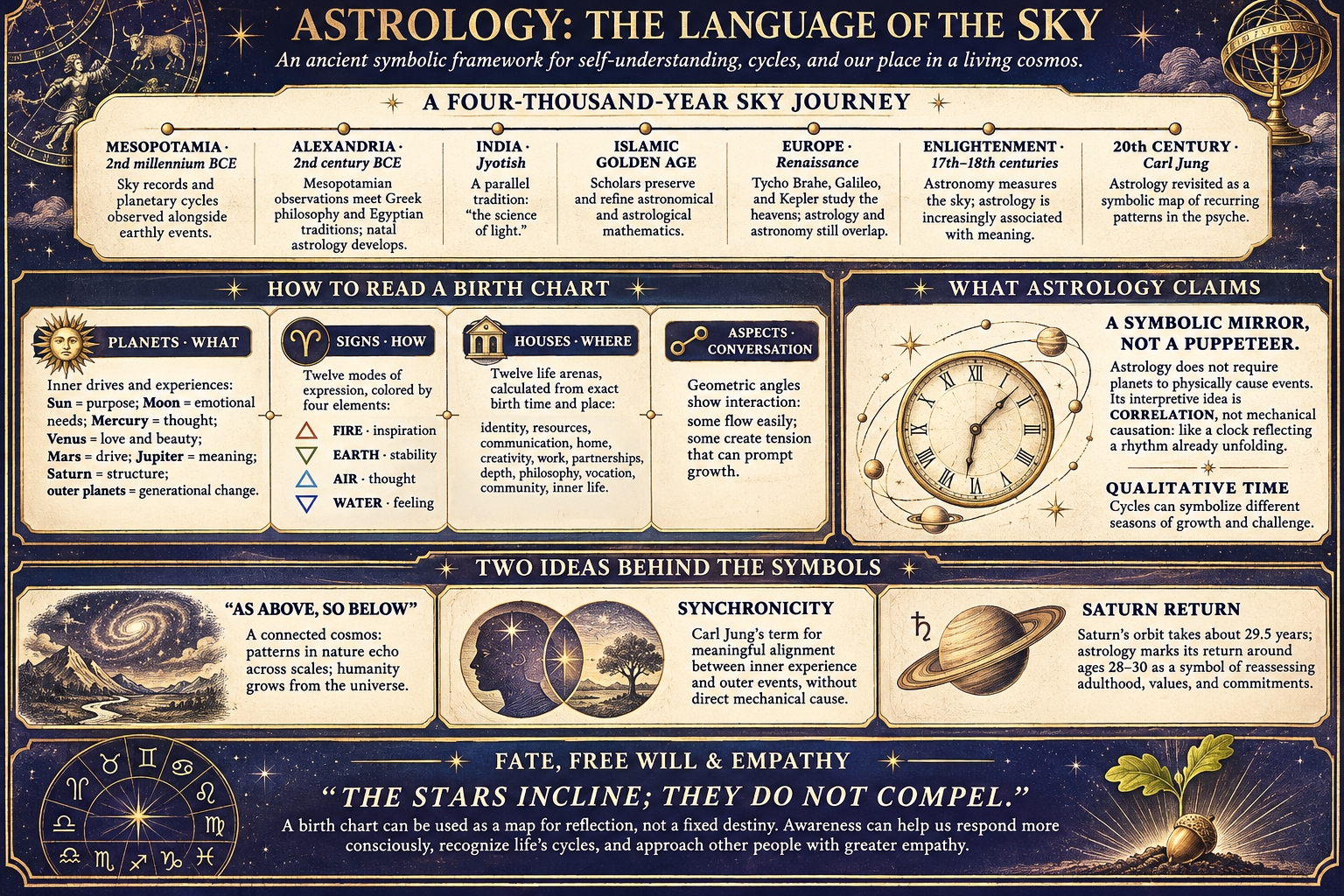
The earliest organized astrological records come from ancient Mesopotamia, more than four thousand years ago. Babylonian priest-scholars meticulously tracked the movements of the Sun, the Moon, and the five visible planets, Mercury, Venus, Mars, Jupiter, and Saturn, alongside earthly events such as floods, harvests, droughts, and the rise and fall of kings. Over centuries of patient observation, they noticed recurring correlations between celestial cycles and collective human affairs.
Around the second century BCE, this Mesopotamian body of observation merged with Greek philosophy and Egyptian spiritual traditions in cosmopolitan Alexandria. Out of that cultural crossroads emerged natal astrology, the remarkable idea that the heavens did not reflect only the fate of empires, but also the unique character and life path of an individual human being born at a specific moment. Meanwhile, in India, a parallel and equally sophisticated tradition known as Jyotish ("the science of light") developed its own rich framework, which remains deeply embedded in Indian culture today.
For most of recorded history, astrology and astronomy were not enemies; they were twin disciplines practiced by the same scholars. During the Islamic Golden Age, polymaths preserved, translated, and refined classical astrological mathematics alongside optics and medicine. Centuries later in Europe, pioneers of the scientific revolution, including Tycho Brahe, Galileo Galilei, and Johannes Kepler, all cast astrological charts and engaged seriously with the craft. Kepler, who discovered the mathematical laws of planetary motion, rejected shallow fortune-telling yet remained convinced from decades of empirical observation that the geometric harmonies of the sky corresponded meaningfully with life on Earth.
The great divorce arrived during the Enlightenment of the seventeenth and eighteenth centuries. As the Western worldview shifted toward a mechanistic model, picturing the universe as a vast, lifeless machine made of separate physical parts, anything that could not be weighed, isolated in a laboratory, or explained by direct mechanical force was pushed to the margins. Astronomy kept the measurement of the sky; astrology was left with its meaning.
Yet astrology never vanished. In the twentieth century, it underwent a quiet renaissance through its dialogue with depth psychology. The Swiss psychiatrist Carl Jung, who studied astrology extensively and even used birth charts in difficult clinical cases, saw it not as a relic of magical thinking, but as humanity’s oldest encyclopedia of the psyche, a symbolic map of the recurring patterns, drives, and inner tensions that shape every human life.
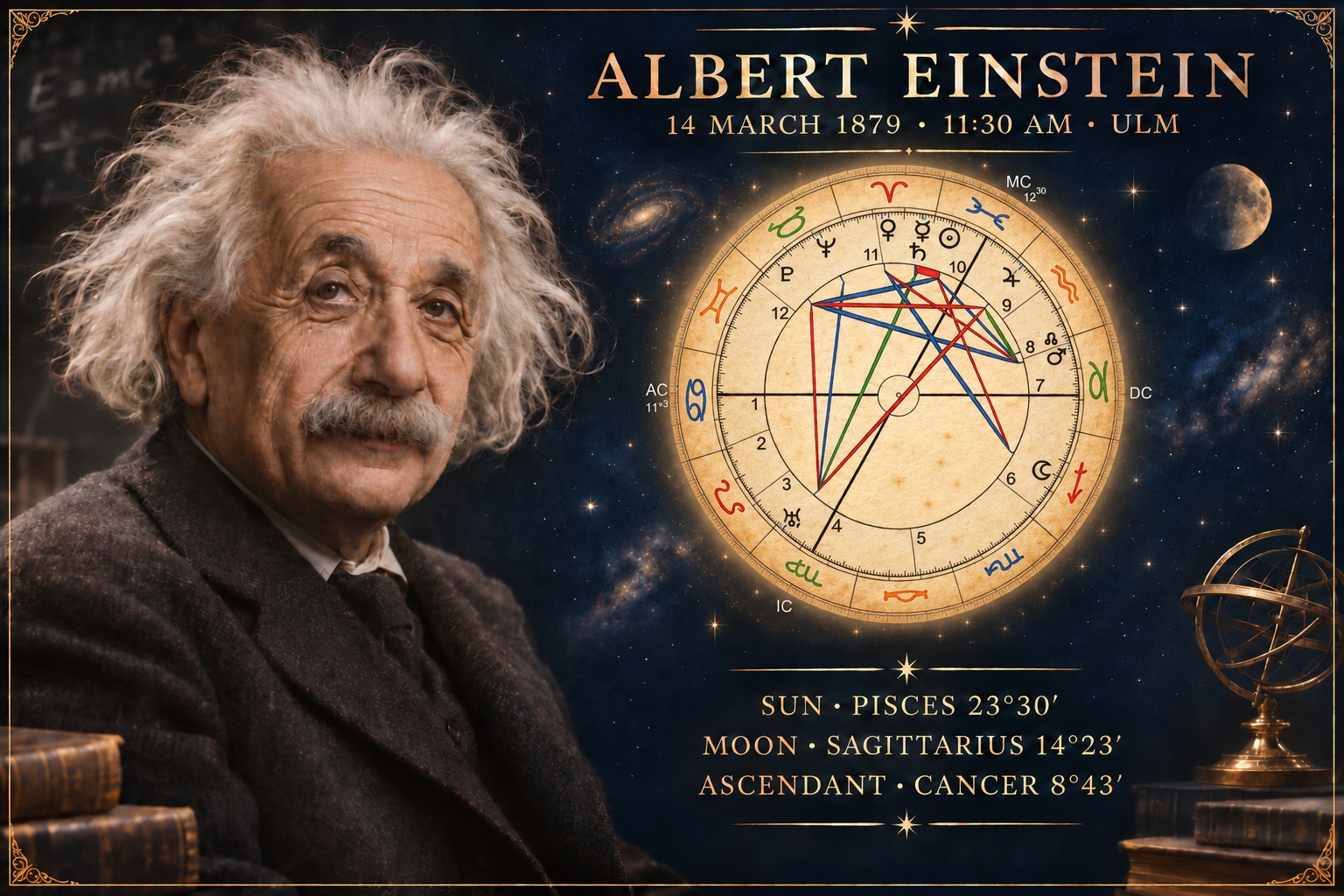
The astrological birth chart of Albert Einstein.
Beyond the Sun Sign: What a Birth Chart Actually Is
To understand how an astrologer works today, it helps to step away from the idea that you are simply "an Aries" or "a Pisces." Your Sun sign is only one instrument in an entire orchestra.
When a professional astrologer sits down with you, they work with your natal chart (or birth chart). Technically, it is an astronomical map of the solar system captured from the exact geographic coordinates and minute of your birth. Because the Earth rotates continuously on its axis while orbiting the Sun, even two people born on the same day, or in different cities at the same hour, will have noticeably different charts.
A birth chart can look intimidating at first glance, filled with glyphs, lines, and degrees. Underneath the symbols, however, its grammar rests on four clear pillars:
- The Planets (The What): Each celestial body represents a distinct dimension of human experience or inner drive. The Sun reflects your core vitality and sense of purpose; the Moon speaks to your emotional needs, instincts, and inner security; Mercury describes how you think and communicate; Venus relates to how you love, connect, and experience beauty; Mars represents drive, courage, and how you assert yourself. Further out, Jupiter and Saturn bridge the personal and the social, Jupiter governing expansion, meaning, and faith, and Saturn governing structure, discipline, boundaries, and maturity. The slow-moving outer planets, Uranus, Neptune, and Pluto, speak to deeper generational shifts and profound personal transformation.
- The Zodiac Signs (The How): The twelve signs are not arbitrary labels; they represent twelve archetypal modes of expression, rooted in the seasonal cycle of the Northern Hemisphere and organized around the four classical elements, Fire (inspiration and action), Earth (stability and form), Air (thought and connection), and Water (feeling and intuition). Importantly, every person has all twelve signs somewhere in their chart. The sign a planet occupies colors how that psychological drive expresses itself. Mars in fiery Aries acts swiftly and directly; Mars in earthy Taurus moves with steady, unstoppable persistence.
- The Houses (The Where): Calculated from your exact time and place of birth, the twelve houses divide your chart into the concrete arenas of earthly life, self-identity, resources, communication, home and family, creativity, daily work, partnerships, shared depth, philosophy, vocation, community, and the quiet inner world of the unconscious. If a planet is an actor and the sign is the costume it wears, the house is the stage on which the scene unfolds.
- The Aspects (The Conversation): Planets do not sit in isolation; they form precise geometric angles to one another, conjunctions, squares, trines, and oppositions. These angles show how different parts of your personality interact. Some angles indicate effortless flow and natural talent; others reveal creative friction, like a deep need for freedom standing face to face with a deep longing for belonging, that pushes us to grow into more integrated human beings.
Together, these layers create a portrait of astonishing specificity. A birth chart does not put you in a box; it shows the complex, sometimes paradoxical symphony of energies you carry within you.
The Question Everyone Asks: Why Does It Work?
Whenever someone experiences a thorough astrological reading for the first time, they often leave with a mixture of wonder and bewilderment. How could a diagram of planetary positions describe the exact emotional crossroads I have been navigating for the past two years?
To answer that honestly, we first have to clear away the biggest misconception surrounding astrology: the myth of physical causation.
Many critics assume astrologers believe that Mars beams invisible rays of anger down to Earth, or that the gravitational pull of Jupiter rearranges your career. Serious astrologers, both ancient and modern, do not make that claim. The gravitational tug of the obstetrician who delivered you was far stronger than the gravity of Saturn at the moment of your birth. If you try to explain astrology through billiard-ball physics, where one solid object mechanically pushes another, the entire premise collapses.
Astrology does not operate on causation. It operates on correlation.
Consider the clock hanging on your wall. When the hands point to twelve, you feel hungry for lunch. Yet the clock did not cause your hunger, nor did its gears force the Sun to reach the middle of the sky. The clock simply reflects and measures a rhythm that is already unfolding.
Astrology treats the solar system as a vast, living clock, one that measures not quantitative time (how many minutes have elapsed), but qualitative time (what kind of season we are living through). Just as nature moves through spring, summer, autumn, and winter, each inviting a different response from the farmer, human life moves through distinct developmental cycles mirrored by the orbits of the planets.
Why should celestial cycles and inner human experience mirror one another at all? Throughout history, thinkers have pointed to two closely related principles:
- Interconnectedness ("As Above, So Below")
The ancient Hermetic axiom As above, so below; as within, so without expresses a worldview that sees the universe not as a pile of disconnected parts, but as a single, coherent, living whole. Nature loves self-similar patterns. The branching of a river mirrors the veins in a leaf and the bronchial tubes in our lungs; the spiral of a hurricane echoes the spiral of a galaxy. From this perspective, it is not strange that the larger rhythms of the solar system should resonate with the smaller rhythms of human consciousness, because we did not arrive into this cosmos from outside. We grew out of it.
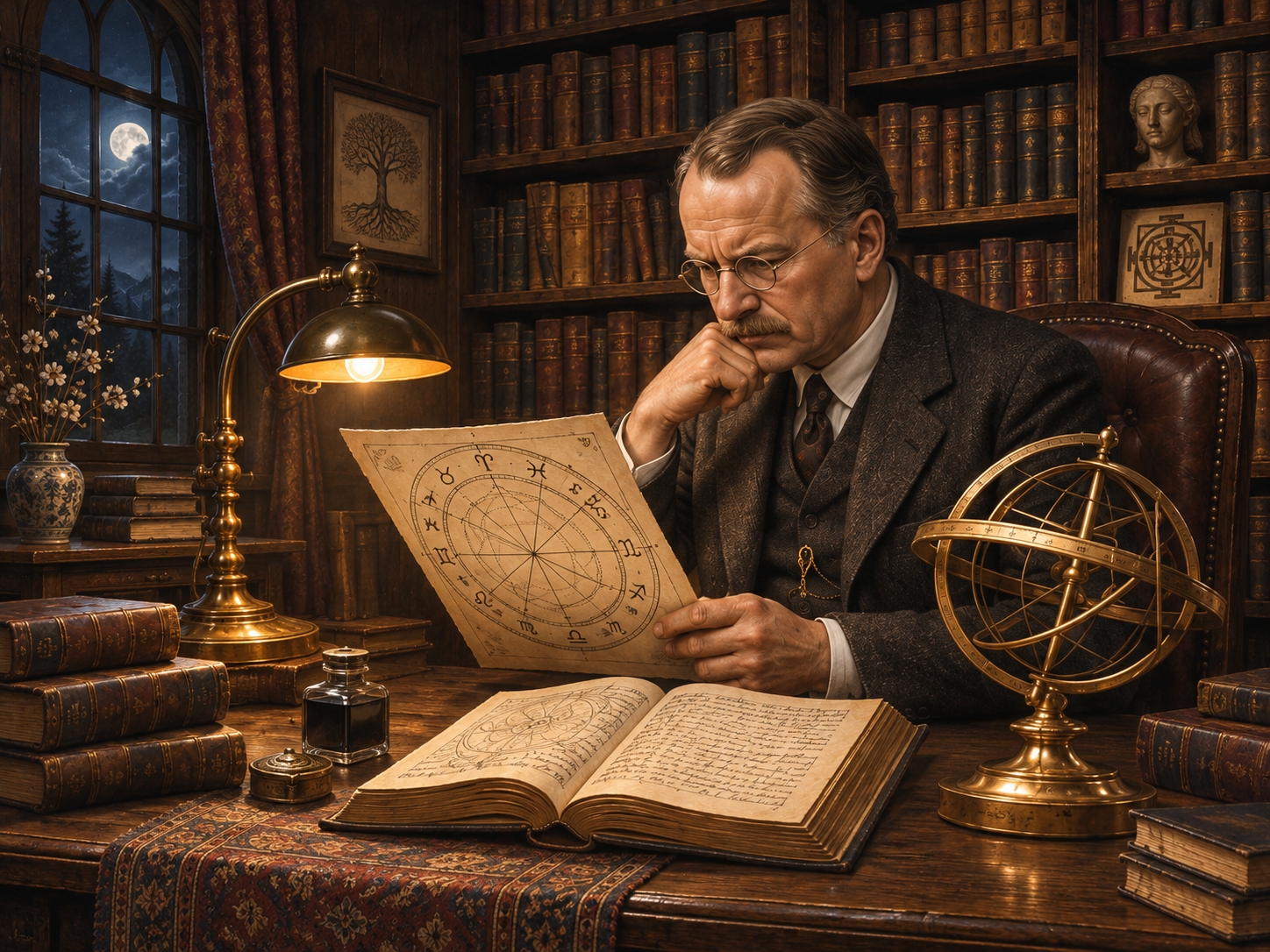
The Swiss psychiatrist Carl Jung studied astrology extensively. The image was generated using ChatGPT.
- Synchronicity and Archetypal Timing
Carl Jung coined the term synchronicity to describe meaningful coincidences where an inner psychological state and an outer event align without one mechanically causing the other. Astrology appears to be a structured, cyclical expression of synchronicity.
Take one of the most universally recognizable astrological milestones: the Saturn Return. Saturn takes roughly twenty-nine and a half years to complete one full orbit around the Sun. Between ages twenty-eight and thirty, Saturn returns to the exact place it occupied when you were born. Across cultures and generations, whether a person believes in astrology or has never heard of it, those late-twenties years consistently bring a reckoning with adulthood, a reassessment of career, commitments, values, and who you truly want to become. Saturn does not force that crisis. Rather, the rhythm of Saturn’s orbit and the natural developmental rhythm of human maturity are ticking in unison.
Whether one approaches astrology as an expression of cosmic intelligence, a deep patterning of consciousness, or an archetypal mirror refined over millennia of human observation, its enduring power comes down to lived experience: when studied carefully, the symbols speak with uncanny accuracy.
Fate, Free Will, and the Practice of Awareness
A natural concern for newcomers is whether astrology undermines personal freedom. If my chart shows tension around relationships or a demanding cycle ahead, am I trapped by it?
In practice, thoughtful astrology does the exact opposite. The Roman Stoics had a saying often quoted by astrologers: The stars incline; they do not compel. A birth chart is like the seed of an oak tree. It reveals the inherent blueprint, you are an oak, not a willow, yet how tall you grow, how deeply your roots reach, and how gracefully you weather storms depend entirely on your choices, environment, and level of awareness.
In fact, astrology is most valuable precisely because it expands free will. When we are unconscious of our inner patterns, we tend to repeat them automatically, reacting out of old fears, mistaking temporary storms for permanent failure, or forcing action during a season meant for quiet reflection. Knowing the "cosmic weather" does not take the wheel out of your hands; it simply lets you see the road ahead clearly. If you know a heavy rain is coming, you do not cancel your life, you bring a coat, fortify your roof, and welcome the water that will nourish the next harvest.
Equally transformative is what astrology does for empathy. Once you see that a partner, child, or colleague genuinely operates from a different inner wiring, that what feels like emotional detachment to you may simply be their chart’s natural way of processing feelings through quiet reflection, judgment begins to soften. You stop demanding that everyone walk at your pace or speak your emotional dialect. You begin to appreciate diversity not as an obstacle, but as part of a larger design.
Remembering Our Place in the Rhythm of Life
We live in a remarkable yet disorienting moment in human history. Technological change accelerates every year, our attention is fractured into seconds, and many of our global crises stem from a quiet, pervasive illusion of separation, the belief that humanity stands apart from nature, from one another, and from the wider universe.
In such a world, turning toward astrology is not a step backward into pre-scientific superstition. Practiced with humility, discernment, and intelligence, it is a step toward deeper coherence. It reminds us that growth is cyclical, not linear; that periods of breakdown often prepare the ground for renewal; and that our inner lives are never trivial, because inner awareness shapes everything we build in the outer world.
You do not need to accept astrology on blind faith. Like any worthwhile language, it asks only for curiosity, patience, and honest observation. Look at your own life with fresh eyes, notice the seasons as they turn, and stay open to the possibility that the sky above us is not an empty void, it is a mirror reflecting a universe that is far more alive, meaningful, and interconnected than we have been taught to believe.
INFOGRAPHIC