What Humanity Can Become

What Humanity Can Become

Beyond the Shadow of Fear

If we look at the future solely through the lens of our current headlines, it is easy to believe that humanity is marching toward inevitable decline. For decades, our collective imagination has been dominated by images of ecological collapse, technological alienation, and endless division. Yet history teaches us that the darkest moments before a dawn are often the birth pangs of a profound awakening.

What if the crises of our present era are not the end of the human story, but the shedding of an outdated skin? When we dare to lift our gaze beyond the noise of the present moment, another possibility comes into sharp focus, a future where humanity has finally grown into its spiritual and ecological maturity. This is not a naive utopia free of human complexity, but a realistic, attainable horizon built on a simple shift in consciousness: the realization that we are not separate from one another, from the Earth, or from the living universe.

Cities That Breathe Like Forests

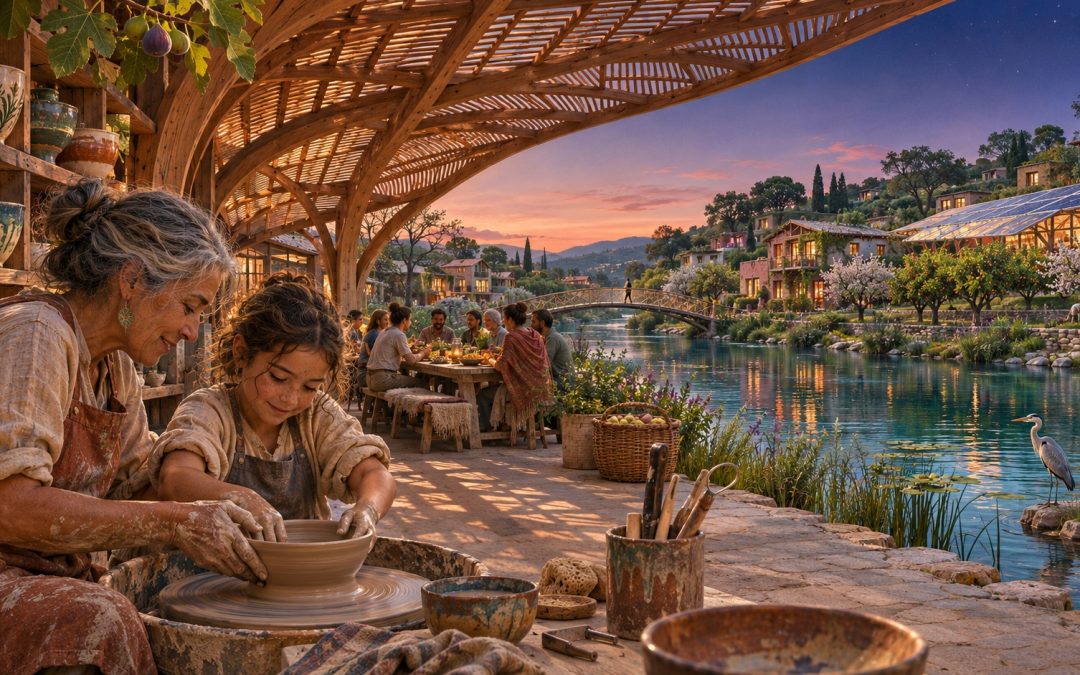
In this conscious future, the way we inhabit the Earth has been completely reimagined. The gray, sprawling concrete metropolises of the industrial age have gradually transformed into living ecosystems. Architecture no longer imposes itself upon the landscape; it grows with it.

Buildings curve organically from sustainable timber, living stone, and self-healing bio-materials, draped in lush vertical forests, terraced gardens, and flowering vines. Rooftops are vibrant sanctuaries of biodiversity and solar canopies that quietly harvest the abundant energy of the sun, sharing clean power freely across entire regions.

Rivers that were once buried beneath asphalt or polluted by industry now flow crystal clear through the heart of our communities, lined with shaded walkways, wildlife corridors, and wooden bridges. The air carries the scent of rain, blossoms, and fresh earth rather than exhaust. Noise pollution has given way to the sound of birdsong, rustling leaves, and human conversation. Cities are no longer machines for working and consuming; they are sanctuaries designed to nourish the human soul and restore the natural world.

An Economy of Regeneration and Generosity

Beneath this physical transformation lies a deeper shift in how we value life. The old economic story, built on endless extraction, artificial scarcity, and relentless competition, has quietly dissolved. In its place has emerged an economy rooted in regeneration, cooperation, and shared wellbeing.

Success is no longer measured by the accumulation of material wealth at the expense of others, but by the health of our ecosystems, the vitality of our communities, and the depth of human flourishing. Local permaculture farms and food forests weave through both rural landscapes and urban neighborhoods, providing abundant, nutrient-rich food for every human being.

Work itself has been liberated from the struggle for mere survival. With essential needs met through clean energy, regenerative agriculture, and wise resource stewardship, human beings are free to ask a far more meaningful question: How am I called to serve and create? People dedicate their lives to craftsmanship, healing, ecological restoration, scientific discovery, philosophy, and the arts, offering their unique gifts out of joy and purpose rather than fear.

Technology in Service of Life

In this world, humanity has neither rejected technology nor surrendered its soul to it. Instead, we have brought technology into alignment with wisdom. Artificial intelligence, clean energy, and advanced materials are no longer tools for surveillance, distraction, or domination; they act as quiet, harmonious servants to life.

Technology handles the heavy, repetitive burdens of society, cleans our oceans, restores depleted soils, and connects global knowledge in an instant, freeing human beings to spend their time on what matters most: presence, creativity, deep relationships, and inner growth. Digital spaces are designed not to fragment our attention or amplify outrage, but to foster genuine understanding, cross-cultural collaboration, and collective intelligence.

Communities of Belonging and Wisdom

Perhaps the most profound beauty of this future is found in the quality of human relationships. The quiet epidemic of loneliness that once haunted modern societies has healed, replaced by a deep, lived sense of belonging.

Neighborhoods are structured around shared commons, courtyards, libraries, workshops, and gardens, where people naturally gather across generations. Elders are no longer pushed to the margins of society; they are honored as keepers of wisdom, storytellers, and mentors who guide the young with patience and perspective.

Children grow up surrounded by extended community, spending as much time learning in forests and gardens as they do in classrooms. Education is no longer about memorizing facts to compete in a market; it is the art of drawing out each child's innate curiosity, emotional intelligence, empathy, and sense of wonder. From their earliest years, children know in their bones that they are safe, that they belong, and that they are an integral part of a living, intelligent cosmos.

Diversity, of culture, thought, temperament, and expression, is no longer viewed as a threat to be feared or homogenized, but as the very source of humanity's resilience and beauty. Conflicts still arise, as they always will among growing beings, yet they are met with deep listening, restorative dialogue, and a shared commitment to truth rather than victory.

Awakening to Our Cosmic Citizenship

As humanity heals its relationship with itself and the Earth, our perspective naturally expands outward. Looking up at the night sky, now brilliant and unclouded by light pollution, we no longer feel like isolated accidents clinging to a lonely rock in an indifferent void.

Guided by expanded awareness, contemplative practices, and a deeper understanding of consciousness, humanity recognizes that we live in a vibrant, interconnected universe teeming with intelligence and meaning. Our steps into space are no longer driven by conquest or resource extraction, but by humility, reverence, and the spirit of peaceful exploration. We begin to take our place as mature, responsible citizens of a larger cosmic community.

The Bridge from Here to There

This vision is not a distant dream reserved for some far-off century. Every element of it already exists in seed form today, in regenerative farms, compassionate communities, visionary scientists, artists, and millions of individuals quietly choosing love over fear in their daily lives.

A conscious future is not something we passively wait to receive. It is something we actively call forth the moment we refuse to let fear dictate what we believe is possible. By holding this vision clearly in our hearts and minds, we become the living bridge between the world that is fading and the world that is waiting to be born.


A Vision of the Healed Earth
We cannot build a world we have not first dared to imagine. Set aside the weight of fear and crisis for a few quiet minutes, and take an inner journey into a healed Earth, where living cities, generous communities, and deep peace are already taking root within human consciousness.

---

Before you begin, find a quiet space where you will not be disturbed for the next ten to fifteen minutes. You may read these words slowly, pausing whenever an image comes alive in your mind, or record them in your own voice to guide your journey.

Part 1: Releasing the Old Story
Close your eyes gently, and let your body settle into the support beneath you. Feel the steady pull of the Earth holding you, constant and unconditional.
Take a slow, deep breath in through your nose, filling your lungs completely. Hold that breath for a brief, quiet moment at the top, and then let it go with a long, soft sigh through your mouth. With that exhale, allow the noise of the outside world to fade into the distance.
Every day, our minds are flooded with stories of crisis, division, and fear. Without realizing it, we carry the weight of those dark forecasts in our shoulders, our chests, and our thoughts. Take another deep breath in, and as you exhale, consciously set that weight down. For these next few minutes, you do not need to fix anything. You do not need to worry or analyze. You are simply stepping out of the old story of separation, and opening a doorway to what is possible.
Place one hand lightly over the center of your chest. Feel the quiet rhythm of your heartbeat. Let a gentle warmth gather beneath your palm—a feeling of gratitude for being alive, for breathing, and for possessing the sacred gift of imagination. Remember that what you are about to see is not a distant fantasy. It is a seed of consciousness waiting to take root.
Part 2: Stepping Across the Threshold
Imagine yourself standing on a soft, sunlit pathway. Before you is a shimmering veil of golden morning mist. You know that on the other side of this mist lies the Earth—not as a place of perfection devoid of challenges, but as a living world that has remembered its wisdom. Humanity has chosen unity over fear, stewardship over extraction, and love over separation. [1]
Take a deep breath, and step forward through the mist.
As the golden light clears around you, look down at your feet. You are standing barefoot on cool, rich earth covered in soft moss and clover. A gentle breeze brushes against your skin, carrying the crisp, clean scent of pine, wildflowers, and rain-washed stone. The air feels alive, pure, and effortless to breathe.
Look up and take in the horizon. The sky above is a brilliant, unobstructed blue, stretching endlessly over a landscape that breathes with vitality.
Part 3: The Living Cities
In the distance, you see a city—yet it looks nothing like the gray concrete canyons of the past. This is a city designed as a living ecosystem.
Walk closer and explore its pathways. The buildings rise gracefully in organic curves of timber, stone, and living glass, draped in lush vertical gardens, flowering vines, and fruit trees. Rooftops are vibrant sanctuaries of greenery and solar canopies that quietly drink in the light of the sun, sharing clean energy across the entire community.
There is no harsh roar of traffic here. Instead, you hear the gentle murmur of crystal-clear streams winding directly through the heart of the city, crossed by arched wooden bridges. You hear the joyful chorus of songbirds nesting in ancient oaks that line the wide, pedestrian boulevards. People move at a human pace—walking, cycling, or gliding effortlessly in silent, clean transit.
Notice the atmosphere in the air. There is no rush, no underlying hum of anxiety. Every corner of this city has been built not to isolate people, but to nurture genuine human connection.
Part 4: Communities of Belonging
You enter a sunlit central plaza filled with dappled shade, blooming botanical gardens, and open pavilions. Look closely at the people gathered here.
You see a tapestry of human diversity—faces of every heritage, age, and walk of life—interacting with an unmistakable sense of warmth, safety, and mutual respect. Strangers meet eyes and smile without hesitation. Conversations are unhurried, filled with curiosity and deep listening.
Over beneath a great willow tree, a group of elders sits comfortably on woven cushions, sharing stories and quiet wisdom with a circle of attentive young adults. In this world, aging is not hidden away; elders are deeply honored as the living memory and moral compass of the community.
A few paces away, children are laughing as they tend to a community garden, their hands happily smudged with soil as they plant seeds alongside their parents and neighbors. Watch how these children move through the world. They carry no shadow of existential dread. They are growing up knowing in their very bones that they are safe, that their unique gifts are needed, and that they are inextricably connected to one another, to the Earth, and to the greater web of life.
Part 5: An Economy of Generosity
Walk past an open-air marketplace and observe how people exchange goods, art, and services. Here, the old economy of endless extraction and scarcity has dissolved. In its place thrives an economy built on cooperation, regeneration, and generosity.
Abundant, nutrient-rich food harvested from local permaculture farms is shared freely and equitably, ensuring no one ever knows hunger. Artisans, scientists, healers, and builders offer their creations not out of fear of survival, but from a deep joy of contribution. Technology is no longer a tool for distraction or control; it has become a quiet, harmonious servant to life—restoring oceans, purifying water, and freeing human beings to explore art, philosophy, inner growth, and cosmic discovery.
Notice how your own body feels as you walk through this world. Feel how your shoulders drop, completely free of tension. Your mind is crystal clear. Your heart feels open, expansive, and deeply at peace. You are home.
Part 6: Anchoring the Blueprint
Pause in the center of this sunlit plaza and close your inner eyes for a moment. Let the specific sights and sounds softly dissolve, leaving behind only the pure, unmistakable feeling of this reality.
Feel the profound relief of a healed planet. Feel the warmth of human trust. Feel the quiet certainty that humanity has matured, awakened, and stepped into its true potential.
Breathe that feeling deep into your chest. Allow every cell in your body to absorb this frequency, recognizing it not as a wish, but as an energetic blueprint—an attractor in consciousness that is already drawing the world toward its fulfillment.
Know that you are not alone in holding this vision. Across the globe, countless hearts are awakening to this very same dream, weaving a quiet field of light that grows stronger with every conscious breath.
Part 7: Returning to the Present
Slowly, begin to bring your awareness back to your physical body. Feel your feet resting on the floor, your back against the chair, and the gentle rise and fall of your chest as you breathe.
Bring the warmth of that future world back with you into this present moment. Before you open your eyes, make a quiet promise to yourself: I will not surrender my imagination to fear. Today, through my words, my kindness, and my choices, I am a living bridge to this conscious future.
Take one final, nourishing breath in, and as you exhale, gently open your eyes.
A Vision Beyond Dystopia

A Vision Beyond Dystopia

Note! This is a summary and description of a science fiction book. The book can be purchased here. An earlier version can be downloaded for free. The author of the book is also the founder of Conscious Future World.


Exploring Message from the Future: WE MADE IT!

Science fiction has long been a mirror of our hopes, fears, and anxieties about what lies ahead. From dystopian warnings to thrilling explorations among the stars, the genre reflects a vast spectrum of possible futures. Many classic works emphasize conflict, collapse, or existential risk, highlighting humanity’s struggles against external or internal turmoil. But what if science fiction could take a different approach, not by imagining catastrophe, but by charting a path toward a bright and cohesive future built on collaboration, compassion, and holistic human flourishing?

Message from the Future: WE MADE IT! by Henning Jon Grini is precisely such a work: a science-fiction narrative that eschews dystopia and instead presents a compelling utopian vision of humanity’s near future. Published by GaiaInnovations and based originally on Grini’s earlier Norwegian science fiction novel, this story invites readers to envision how we might overcome our greatest challenges and create a world defined by unity, environmental harmony, and thriving human connections.

The Premise: A Future Worth Believing In

At its core, WE MADE IT! is built on a fundamental optimism: the belief that the future is not fated but shaped by human choices and collective imagination. The narrative begins in a time very much like our own, rooted in the present struggles of environmental decay, social fragmentation, and personal disillusionment. The protagonist, a man in his thirties named Aron, finds himself overwhelmed by life’s pressures, he has lost his job, his marriage has ended, and he views the world around him as chaotic and disheartening.

The story quickly moves from this personal low point into an extraordinary experience: through a mysterious transition, described as a crossing between wakefulness and sleep, Aron is transported into a future society that has resolved many of humanity’s most pressing problems. This future world, hidden from him at first, unfolds gradually as he encounters its people, landscapes, and values.

Instead of revealing a polluted wasteland or tyrannical regime, Grini’s future is astonishingly humane. Poverty, war, crime, and environmental destruction have been abolished or drastically mitigated. Technology exists, but it serves human wellbeing and the natural world rather than fueling greed or inequality. Aron’s bewilderment transforms into curiosity and wonder as he begins to see just how this evolved society operates.

Humanity’s Transformation: From Crisis to Cooperation

One of the central themes of WE MADE IT! is the idea that humanity’s greatest challenges, economic inequality, environmental degradation, social fragmentation, are not insoluble. In the future world Aron visits, these challenges have been addressed through collective effort, deep social cooperation, and broad cultural transformation.

People live in communities that are designed in harmony with nature. Architecture, energy systems, and transportation are all grounded in sustainability. Environmental cleanup is not just a technical achievement but a lived value shared by citizens who understand their interdependence with the Earth. The once rampant pollution and climate instability have given way to cleaner ecosystems and thriving landscapes.

In this future, productivity and invention are still flourishing, but the underlying motivation for progress has shifted from competition and profit to wellbeing and service. Technology is advanced but humble, always subordinate to human needs and ecological balance. Rather than dominating nature, humanity coexists with it, nurturing biodiverse environments and restoring ecosystems once damaged by industrial excess.

Aron learns that this transformation did not happen overnight, nor through magic. It emerged from deliberate choices, a deepening collective empathy, and a redefinition of what success means for societies. In place of GDP and power politics, measures of wellbeing, ecological health, and community cohesion guide decision-making. The shift toward holistic wellbeing becomes less of an ideal and more of a social infrastructure, expressed through education, culture, and governance alike.

Personal Connection and Emotional Growth

While WE MADE IT! is deeply rooted in sociopolitical and environmental transformation, it is equally a human story, one of emotional reconnection, personal discovery, and relational intimacy.

Early in the story, Aron feels alienated and burdened by his past life. Yet as he encounters Natalia, a resident of the future city called Lighthaven, his worldview begins to expand. Natalia embodies the openness, emotional maturity, and balance that characterize this future society. Through their dialogs, Aron learns not just about societal change, but about the inner work that makes that change possible: empathy, vulnerability, and deep regard for others.

Their relationship becomes a vehicle for exploring how this future handles human intimacy differently. Concepts such as love, connection, sexuality, and mutual respect are elevated beyond mere biology; they are expressions of emotional intelligence and shared values. Unlike in the present world Aron left behind, relationships here are free from exploitation, a reflection of a society that has outgrown systemic oppression, abuse, and alienation.

This emphasis on emotional growth is significant. Far from being an afterthought, personal transformation is woven into the fabric of this future world. People are encouraged to understand themselves and others not only intellectually, but emotionally, enabling stronger communities and more resilient individuals. Wherever Aron goes, he sees people who are content not because they live in a perfect world, but because they have learned how to live with meaning, compassion, and mutual support.

Exploration, Innovation, and Cosmic Connection

Beyond societal transformation and personal discovery, WE MADE IT! takes Aron on physical journeys that broaden his sense of possibility. He travels to an advanced space station orbiting Earth and visits a sophisticated underwater research facility that reflect humanity’s mastery of sustainable coexistence with both sea and sky.

In these settings, science and exploration are driven by curiosity and planetary stewardship rather than exploitation or militarism. Space travel, once the domain of nation-states and private corporations, has become a shared human endeavor advancing collective knowledge. Underwater research stations reveal how technological innovation, when guided by ethical principles, can harmonize with nature rather than disrupt it.

But perhaps the most striking moments come when Aron encounters beings from other civilizations. These cosmic friends are not antagonistic visitors, nor are they distant gods arriving to save humanity. Instead, they represent an expanded sense of community, one that extends beyond Earth, suggesting that connection with other intelligent life need not be fraught with fear or conflict. These encounters reinforce the book’s central message: life, in all its forms, is enriched by cooperation and mutual curiosity.

Realism within Utopian Vision

Critics of utopian fiction often argue that a perfect society is unrealistic, overlooking the complexity of human nature and the persistence of social challenges. However, WE MADE IT! confronts this skepticism by grounding its utopia in the struggles of its protagonist and in the tangible steps leading from the present to the future.

The narrative does not pretend that human flaws disappear. Rather, it suggests that growth is possible when individuals choose collective wellbeing over narrow self-interest. The future Grini describes has not magically eradicated suffering; it has transformed societal structures in ways that reduce sources of systemic pain and invite deeper engagement with meaning, purpose, and community.

Moreover, the book underscores that the future is not a distant abstraction but something unfolding now, shaped daily by human choices, imagination, and commitment. Through Aron’s eyes, we see that the journey from disillusionment to hope mirrors the broader trajectory of civilization: moving from fragmentation toward unity, from scarcity toward abundance, and from fear toward openness.

Why This Story Matters Today

In an era where headlines often spotlight crises, climate change, geopolitical instability, economic inequality, WE MADE IT! offers a counterbalance grounded not in denial, but in possibility. Its optimistic narrative is not escapism; it is a reminder that the futures we write in fiction can shape the aspirations we pursue in reality.

By presenting a future where humanity thrives through empathy, collaboration, and innovation, Grini’s work encourages readers to imagine not only what could go wrong, but what could go right. It reframes science fiction not as a genre of fear, but of potential, showing that the stories we tell about tomorrow can influence the choices we make today.

Conclusion: A Message of Hope

Message from the Future, WE MADE IT! is an invitation, to dream boldly and act with purpose. Through Aron’s transformative journey from despair to wonder, readers are offered a vision of a future where humanity’s highest aspirations are realized. Its emphasis on emotional growth, societal harmony, environmental stewardship, and cosmic connection serves as both inspiration and challenge: we are reminded that the future is not preordained but crafted through shared creativity and collective commitment.

In a genre often dominated by dystopian warnings, Grini’s work stands out as a hopeful alternative, urging us to imagine not just what might be avoided, but what might be achieved, together.

INFOGRAPHIC